
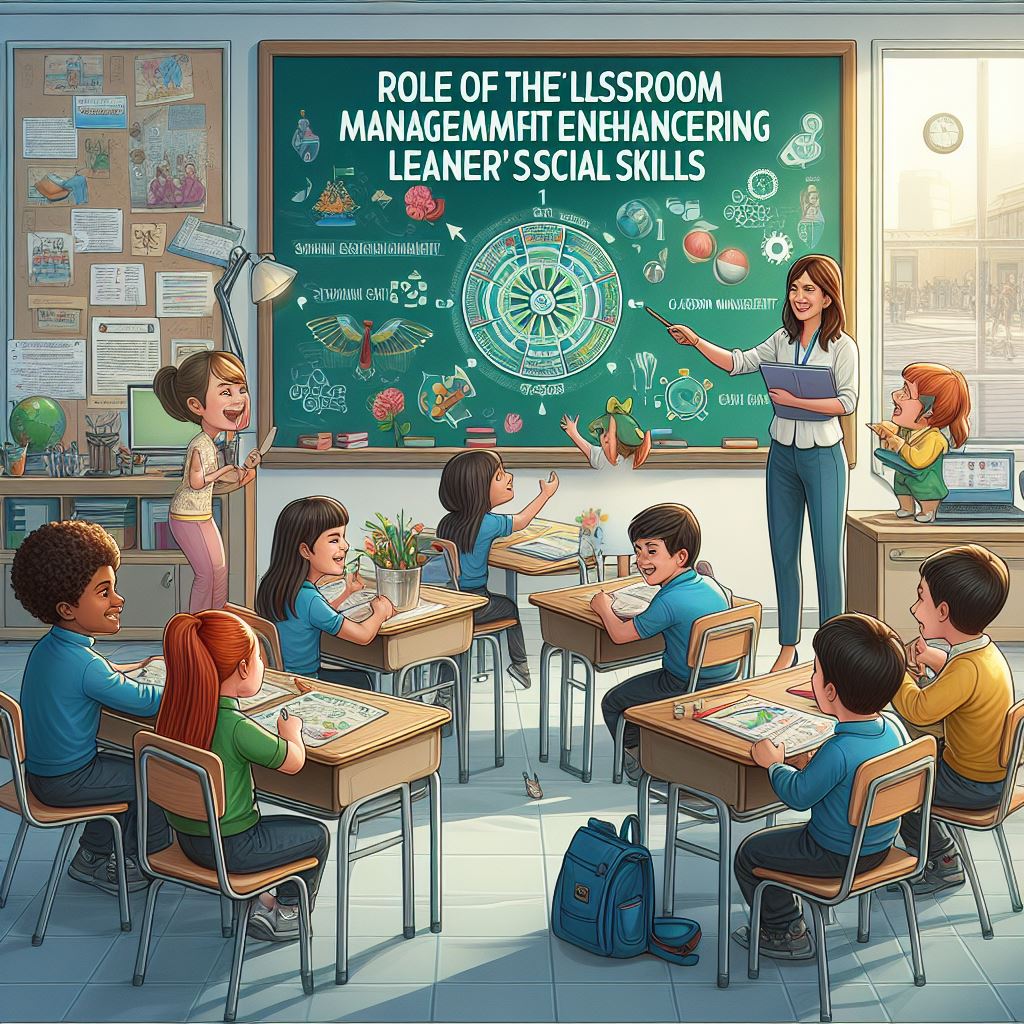
An enquiry into the role of classroom management in enhancing learners’ social skills
DOI:
https://doi.org/10.35564/jmbe.2024.0010Keywords:
Classroom management, physical management, social environment, social skills development, socioeconomic statusAbstract
Learners’ social skills enhancement is one of the key components of the classroom and the basic obligation of a teacher and school. Thus, it is imperative to manage the classroom in a way that can offer a comfortable teaching-learning environment to learners. Therefore, the study aimed to examine to role of classroom management in enhancing learners' social skills. The interpretive research design was utilized to describe the qualitative data, and a generic qualitative research approach was employed to undertake the study. A total of 18 teachers from six secondary schools were selected by using a purposive sampling technique. It was instituted that classroom management and the social environment of the classroom play a vital role in learners' social skills enhancement. Based on research findings, physical resources, teacher role, class rule, conduct and regulation, socioeconomic status of learners, family background, and poverty are the leading factors that have a strapping role on learners’ skills enhancement. The selected schools to accomplish research are lacking resources, however, teachers are considered as a core in teaching-learning. It is, therefore, obligatory to provide resources to classrooms, skills to teachers, and address learners' socioeconomic status to achieve educational goals and enhance social skills.
References
Abubakar, Muhammad, & Tambuwal, (2021) Drugs and substance abuse as a challenge to the management of discipline in secondary schools in Sokoto South local government, Sokoto state, Nigeria. Drugs, 2(5), 150-157. https://www.allmultidisciplinaryjournal.com/uploads/archives/613F2D365219116315302 4.pdf
Amie-Ogan, O. T., Befii-Nwile, C., & Elenwo, P. M. (2021). Management of physical resources for the academic improvement of junior secondary school students in Rivers State Nigeria. International Journal of Progressive and Alternative Education, 7(1), 327-342. https://globalacademicgroup.com/journals/asproaedu/V7N1P22_2021_Asproaedu.pdf
Bessa, C., Hastie, P., Araújo, R., & Mesquita, I. (2019). What do we know about the development of personal and social skills within the sport education model: A systematic review. Journal of sports science & medicine, 18(4), 812. https://pubmed.ncbi.nlm.nih.gov/31827367/
Braun, V., & Clarke, V. (2006). Using thematic analysis in psychology. Qualitative research in psychology, 3(2), 77-101.
https://doi.org/10.1191/1478088706qp063oa
Cassum, S. H., & Gul, R. B. (2017). Creating an enabling environment for student engagement: Faculty practices of critical thinking. International Journal of Higher Education, 6(1), 101. https://doi.org/10.5430/ijhe.v6n1p101
Cedeno, L. F., Martínez-Arias, R., & Bueno, J. A. (2016). Implications of Socioeconomic Status on Academic Competence: A Perspective for Teachers. International Education Studies, 9(4), 257-267. https://doi.org/10.5539/ies.v9n4p257
Creswell, J. W. (2009). Mapping the field of mixed methods research. Journal of mixed methods research, 3(2), 95-108.
https://doi.org/10.1177/1558689808330883
Creswell, J. W., & Poth, C. N. (2016). Qualitative inquiry and research design: Choosing among five approaches. Sage publications. https://us.sagepub.com/en-us/nam/qualitative-inquiry-and-research-design/book266033
Cunningham, H. (2020). Children and childhood in Western society since 1500. Routledge. https://doi.org/10.4324/9781003033165
Domitrovich, C. E., Durlak, J. A., Staley, K. C., & Weissberg, R. P. (2017). Social‐emotional competence: An essential factor for promoting positive adjustment and reducing risk in school children. Child development, 88(2), 408-416. https://doi.org/10.1111/cdev.12739
Duncan, G. J., & Magnuson, K. A. (2014). Off with Hollingshead: Socioeconomic resources, parenting, and child development. In Socioeconomic status, parenting, and child development (pp. 83-106). Routledge. https://www.taylorfrancis.com/chapters/edit/10.4324/9781410607027-5/hollingshead-greg-duncan-katherine-magnuson
Egeberg, H. M., McConney, A., & Price, A. (2016). Classroom Management and National Professional Standards for Teachers: A Review of the Literature on Theory and Practice. Australian Journal of Teacher Education, 41(7), 1-18. https://doi.org/10.14221/ajte.2016v41n7.1
Falsario, H. N., Muyong, R. F., & Nuevaespana, J. S. (2014). Classroom climate and academic performance of education students. https://www.dlsu.edu.ph/wp-content/uploads/pdf/conferences/research-congress-proceedings/2014/LLI/LLI-I-003-FT.pdf
Felisilda, M. M. A., & Torreon, L. C. (2020). Effects of Broken Family on Pupils' Behavioral Development and Academic Success. International Journal of Research-GRANTHAALAYAH, 8(10), 216-223. https://doi.org/10.29121/granthaalayah.v8.i10.2020.1526
Fish, S. (2021). Is there a text in this class? In Campus Wars (pp. 49-56). Routledge. https://doi.org/10.4324/9780429038556-6
Garbarino, J. (2017). Children and families in the social environment: Modern applications of social work (2nd ed.) Routledge.
https://doi.org/10.4324/9781315081397
Garbarino, J. (1992). Children and Families in the Social Environment: Modern Applications of Social Work (2nd ed.). Routledge. https://doi.org/10.4324/9781315081397
Glasser, W. (1999). Choice theory: A new psychology of personal freedom. Harper Perennial. https://psycnet.apa.org/record/1999-02074-000
Gremmen, M. C., Van Den Berg, Y. H., Segers, E., & Cillessen, A. H. (2016). Considerations for classroom seating arrangements and the role of teacher characteristics and beliefs. Social Psychology of Education, 19, 749-774. https://doi.org/10.1007/s11218-016-9353-y
Gueldner, B. A., Feuerborn, L. L., & Merrell, K. W. (2020). Social and emotional learning in the classroom: Promoting mental health and academic success. Guilford Publications. https://doi.org/10.1080/00220671.2020.1836851
Heard, D., & Lake, B. (2018). The challenge of attachment for caregiving. Routledge. https://doi.org/10.4324/9780429481260
Hosokawa, R., & Katsura, T. (2017). A longitudinal study of socioeconomic status, family processes, and child adjustment from preschool until early elementary school: the role of social competence. Child and adolescent psychiatry and mental health, 11(1), 1-28. https://doi.org/10.1186/s13034-017-0206-z
Hoque, K. E., & Raya, Z. T. (2023). Relationship between principals' leadership styles and teachers' behavior. Behavioral Sciences, 13(2), 111. https://doi.org/10.3390/bs13020111
Hoff, E., & Laursen, B. (2019). Socioeconomic status and parenting. In Handbook of parenting (pp. 421-447). Routledge.
https://doi.org/10.4324/9780429401459-13
Irshadullah, H. M., & Inamullah, H. M. (2016). Democracy and Social Responsibility at the Secondary Level in Khyber Pakhtunkhwa. Dialogue (Pakistan), 11(1). https://www.qurtuba.edu.pk/thedialogue/The%20Dialogue/11_1/Dialogue_January_March2016_47-63.pdf
Jalili, S., & Mall-Amiri, B. (2015). The difference between extrovert and introvert EFL teachers' classroom management. Theory and Practice in Language Studies, 5(4), 826. https://doi.org/10.17507/tpls.0504.19
Kohn, A. (2006). Beyond discipline: From compliance to community. ASCD. https://eric.ed.gov/?id=ED494284
Kounin, J. S. (1970). Discipline and group management in classrooms. Holt, Rinehart & Winston. https://psycnet.apa.org/record/1973-07871-000
Livingstone, S., & Sefton-Green, J. (2016). The class: Living and learning in the digital age (Vol. 1). NYU Press. https://www.jstor.org/stable/j.ctt18040ft
Lyman, M. D. (2016). Drugs in society: Causes, concepts, and control. Routledge. https://doi.org/10.4324/9781315474373
Lopes, J., Silva, E., Oliveira, C., Sass, D., & Martin, N. (2017). Teacher's classroom management behavior and students' classroom misbehavior: A study with 5th through 9th-grade students. https://doi.org/10.25115/ejrep.43.17075
Lucas, B., & Spencer, E. (2017). Teaching Creative Thinking: Developing learners who generate ideas and can think critically (Pedagogy for a Changing World series). Crown House Publishing Ltd. https://www.researchgate.net/publication/320324550
Main, G. (2019). Money matters A nuanced approach to understanding the relationship between household income and child subjective well-being. Child Indicators Research, 12(4), 1125-1145. https://doi.org/10.1007/s12187-018-9574-z
Meade, C. S., Towe, S. L., Watt, M. H., Lion, R. R., Myers, B., Skinner, D., ... & Pieterse, D. (2015). Addiction and treatment experiences among active methamphetamine users recruited from a township community in Cape Town, South Africa: A mixed-methods study. Drug and alcohol dependence, 152, 79-86. https://doi.org/10.1016/j.drugalcdep.2015.04.016
Medeiros, H. C. P., Soares, A. B., & Monteiro, M. C. (2021). Adolescent social skills, perception of social support and motivation to learn: The impact on school performance. Psico-USF, 26, 533-543. https://doi.org/10.1590/1413-82712021260311
Merrell, K. W., & Gimpel, G. (2014). Social skills of children and adolescents: Conceptualization, assessment, treatment. Psychology Press. https://doi.org/10.4324/9781315805757
Nafa, M. S. (2022). Operative Classroom Management Strategies. Journal of Positive School Psychology, 6(9), 5022-5036.
https://doi.org/10.1111/josh.13279
Ncontsa, V. N., & Shumba, A. (2013). The nature, causes, and effects of school violence in South African high schools. South African journal of education, 33(3), 1-15. https://doi.org/10.15700/201503070802
Nisar, M., Khan, I. A., & Khan, F. (2019). Relationship between Classroom Management and Students Academic Achievement. Pakistan Journal of Distance and Online Learning, 5(1), 209-220. https://files.eric.ed.gov/fulltext/EJ1266806.pdf
Pangrazi, R. P., & Beighle, A. (2019). Dynamic physical education for elementary school children. Human Kinetics Publishers. https://search.worldcat.org/search?q=isbn%3A1492590266
Pan, X., & Chen, W. (2021). Modeling teacher supports self-directed language learning beyond the classroom: technology acceptance and technological self-efficacy as mediators. Frontiers in Psychology, 12, 751017. https://www.mendeley.com/catalogue/cfaa745f-d2a8-3ee2-a944-79446ec9b68a/
Puteh, M., Che Ahmad, C. N., Mohamed Noh, N., Adnan, M., & Ibrahim, M. H. (2015). The classroom physical environment and its relation to teaching and learning comfort level. International Journal of Social Science and Humanity, 5(3), 237-240. https://doi.org/10.7763/IJSSH.2015.V5.460
Richards, J. C. (2022). Exploring emotions in language teaching. Relc Journal, 53(1), 225-239. https://doi.org/10.1177/0033688220927531
Shukla, T., Dosaya, D., Nirban, V. S., & Vavilala, M. P. (2020). Factors extraction of effective teaching-learning in online and conventional classrooms. International Journal of Information and Education Technology, 10(6), 422-427. http://dx.doi.org/10.18178/ijiet.2020.10.6.1401
Sithole, N. (2017). Promoting a positive learning environment: School setting investigation. Master of Education with specialization in Curriculum and Instructional Studies. University of South Africa. http://hdl.handle.net/10500/24348
Sieberer-Nagler, K. (2016). Effective classroom management and positive teaching. English Language Teaching, 9(1), 163-172. https://doi.org/10.5539/elt.v9n1p163
Singh, A. (2014). Conducive classroom environment in schools. International Journal of Science and Research (IJSR) ISSN (Online): 2319-7064 Volume 3 Issue 1, January 2014 www.ijsr.net. https://www.ijsr.net/archive/v3i1/MDIwMTM4MzE=.pdf
Silverman, R. M., & Patterson, K. (2021). Qualitative research methods for community development. Routledge. https://doi.org/10.4324/9781003172925
Stronge, J. H. (2018). Qualities of effective teachers. Ascd. https://books.google.co.za/books/about/Qualities_of_Effective_Teachers.html?id=0-qi4i1las8C&redir_esc=y
Stough, L., & Montague, M. L. (2015). How teachers learn to be classroom managers. https://oaktrust.library.tamu.edu/handle/1969.1/155336
Suleman, Q., & Hussain, I. (2014). Effects of classroom physical environment on the academic achievement scores of secondary school students in Kohat division, Pakistan. International Journal of Learning & Development, 4(1), 71-82.
https://doi.org/10.5296/ijld.v4i1.5174
Tajalli, F., Moradan, A., & Farjami, H. (2022). Iranian EFL Learners' Perceptions of Collaborative versus Individual Testing. Journal of New Advances in English Language Teaching and Applied Linguistics, 4(2), 948-966. https://www.jeltal.ir/article_159660_c750d44982a29c1fc13037af275f8893.pdf
Taylor, R. D., Oberle, E., Durlak, J. A., & Weissberg, R. P. (2017). Promoting positive youth development through school‐based social and emotional learning interventions: A meta‐analysis of follow‐up effects. Child development, 88(4), 1156-1171. https://doi.org/10.1111/cdev.12864
Tracy (2019). Qualitative research methods: Collecting evidence, crafting analysis, communicating impact. John Wiley & Sons. https://doi.org/10.1080/22041451.2019.1688620
Unity, O., Osagiobare, O., & Edith, O. (2013). The Influence of Poverty on Students Behaviour and Academic Academic Achievement. Educational Research International, 2(1), 2-1. http://www.erint.savap.org.pk/PDF/Vol.2(1)/ERInt.2013(2.1-19).pdf
Williams, A., Sethi, B., Duggleby, W., Ploeg, J., Markle-Reid, M., Peacock, S., & Ghosh, S. (2016). A Canadian qualitative study exploring the diversity of the experience of family caregivers of older adults with multiple chronic conditions using a social location perspective. International Journal for Equity in Health, 15, 1-16. https://doi.org/10.1186/s12939-016-0328-6
Downloads
Published
Issue
Section
License
Copyright (c) 2024 Journal of Management and Business Education

This work is licensed under a Creative Commons Attribution-NonCommercial-ShareAlike 4.0 International License.
License terms at: https://creativecommons.org/licenses/by-nc/4.0/legalcode