Developing self-regulated learning in accounting students: A guide for educators
DOI:
https://doi.org/10.35564/jmbe.2025.0003Keywords:
Self-regulated learning, Educators, Self-regulated learning models, Integrated, Action research, accounting, studentsAbstract
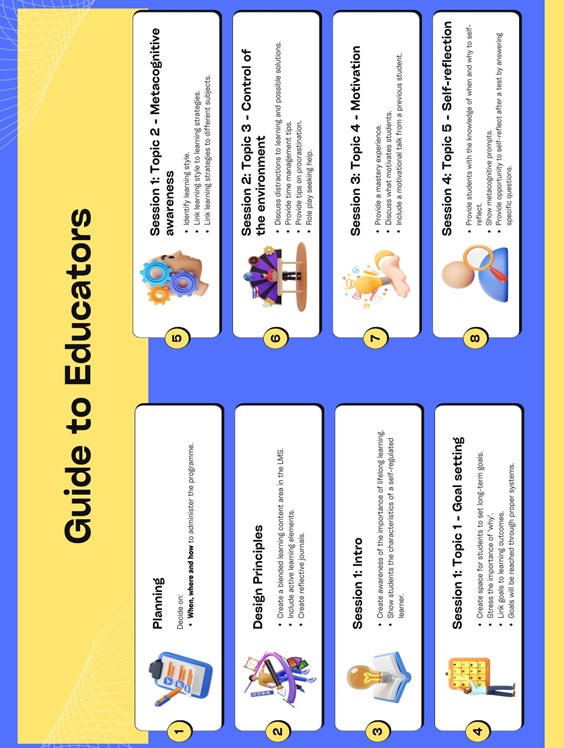
Higher education educators need to equip students with self-regulated learning skills to keep up with ongoing global changes. Self-regulated learning is the ability of a student to set learning goals, monitor progress, adjust strategies, and control their learning process. There are different models proposed in the literature to develop and enhance the self-regulation process. The objective of this paper is to develop a practical programme based on self-regulated learning models for educators to incorporate into their existing curriculum, aiming to enhance students' self-regulated learning skills, particularly within an accounting curriculum. Using an action research methodology, the programme was developed through two action research cycles, with both quantitative and qualitative data collected and analysed. The findings indicate that the proposed programme, grounded in self-regulated learning models, helped students take control of their learning process by setting goals, reflecting on their progress, managing their learning environment, and staying motivated. The paper demonstrates how educators can integrate this programme into their curriculum, offering valuable strategies for fostering self-regulated learning, which is crucial for students' academic success and future professional development in a rapidly changing global environment.
References
Ainscough, L., Stewart, E., Colthorpe, K. & Zimbardi, K. (2017) Learning hindrances and self-regulated learning strategies reported by undergraduate students: Identifying characteristics of resilient students. Studies in Higher Education, 43(12), 2194-2209. http://dx.doi.org/10.1080/03075079.2017.1315085
Anthonysamy, L., Koo, A.C. & Hew, S.H. (2020). Self-regulated learning strategies in higher education: Fostering digital literacy for sustainable lifelong learning. Education and Information Technologies, 25, 2393-2414. https://doi.org/10.1007/s10639-020-10201-8
Asonitou, S. (2021). Impediments and pressures to incorporate soft skills in Higher Education accounting studies. Accounting Education, 31(3), 243-272. https://doi.org/10.1080/09639284.2021.1960871
Baker, C.R. & Logan, L.B. (2006). Using action research to promote increased academic success for educationally disadvantaged students. Global Perspectives on Accounting Education, 3, 1-21.
Becker, L.L. (2011). Self-Regulated Learning in an Introductory Undergraduate Accounting Course. Doctoral dissertation, East Tennessee State University, Paper 1337. Retrieved from: https://dc.etsu.edu/etd/1337
Becker, L.L. (2013). Self-regulated learning interventions in the introductory accounting course: An empirical study. Issues in Accounting Education, 28(3), 435-460. https://doi.org/10.2308/iace-50444
Biggs, J. & Tang, C. (2011). Teaching for quality learning at university: What the student does (4th ed.). McGraw-Hill Education
Boekaerts, M. (1996). Self-regulated learning at the junction of cognition and motivation. European Psychologist, 1(2), 100-112. https://doi.org/10.1027/1016-9040.1.2.100
Boekaerts, M. (1997). Self-regulated learning: A new concept embraced by researchers, policy makers, educators, teachers, and students. Learning and Instruction, 7, 161-186. https://doi.org/10.1016/S0959-4752(96)00015-1
Bowles, M., Ghosh, S. & Thomas, L. (2020). Future-proofing accounting professionals: Ensuring graduate employability and future readiness. Journal of Teaching and Learning for Graduate Employability, 11(1), 1-21. https://doi.org/10.21153/jtlge2020vol11no1art886
Brooks, R. & Everett, G. (2008). The impact of higher education on lifelong learning. International Journal of Lifelong Education, 27(3), 239-254. https://doi.org/10.1080/02601370802047759
Cunningham, B.M. (2008). Using action research to improve learning and the classroom environment. Issues in Accounting Education, 23(1), 1-30. https://doi.org/10.2308/iace.2008.23.1.1
Curtis, S.M. (2017). Pathway to reform: Developing action research capacity in accounting education. Issues in Accounting Education, 32(3), 51-79. https://doi.org/10.2308/iace-51586
Gibbs, P., Cartney, P., Wilkinson, K., Parkinson, J., Cunningham, S., James-Reynolds, C., Zoubir, T., Brown, V., Barter, P., Sumner, P., MacDonald, A., Dayananda, A. & Pitt, A. (2017). Literature review on the use of action research in higher education. Educational Action Research, 25(1), 3-22. https://doi.org/10.1080/09650792.2015.1124046
Gleason, N.W. (2018). Singapore’s higher education systems in the era of the Fourth Industrial Revolution: Preparing lifelong learners, in N.W. Gleason (Ed.). Higher Education in the Era of the Fourth Industrial Revolution, Springer Nature. https://doi.org/10.1007/978-981-13-0194-0_7
Hadwin, A.F., Järvelä, S. & Miller, M. (2011). Self-regulation, co-regulation and shared regulation in collaborative learning environments, in D.H. Schunk & J.A. Greene (Eds.). Handbook of Self-regulation of Learning and Performance, Routledge. https://doi.org/10.4324/9781315697048-6
Hazelton, J. & Haigh, M. (2010). Incorporating sustainability into accounting curricula: Lessons learnt from an action research study. Accounting Education, 19(1-2), 159-178. https://doi.org/10.1080/09639280802044451
Jansen, R.S., Van Leeuwen, A., Janssen, J., Conijn, R. & Kester, L. (2020). Supporting learners’ self-regulated learning in Massive Open Online Courses. Computers & Education, 146, 103771. https://doi.org/10.1016/j.compedu.2019.103771
Kan, A.U. & Murat, A. (2020). Examining the self-efficacy of teacher candidates’ lifelong learning key competences and educational technology standards. Education and Information Technologies, 25, 707-724. https://doi.org/10.1007/s10639-019-10072-8
Karlen, Y. & Hertel, S. (2024). Inspiring self-regulated learning in everyday classrooms: Teachers’ professional competences and promotion of self-regulated learning. Unterrichtswissenschaft, 52, 1-13. https://doi.org/10.1007/s42010-024-00196-3
Kayembe, C. & Nel, D. (2019). Challenges and opportunities for education in the Fourth Industrial Revolution. African Journal of Public Affairs, 11(3), 79-94. https://doi.org/10.10520/EJC-19605d342e
Kueenzi, S. (2023). Towards a better conceptual understanding of how students learn business research methods. Journal of Management and Business Education, 6(3), 415-431. https://doi.org/10.35564/jmbe.2023.0022
Lima Filho, R. & Casa Nova, S. (2019). Self-regulated learning and self-determination theory in accounting graduate students in Brazil. European Journal of Scientific Research, 152(3), 236-255.
Love, D. (2011). Lifelong learning: Characteristics, skills, and activities for a business college curriculum. Journal of Education for Business, 86(3), 155-162. https://doi.org/10.1080/08832323.2010.492050
Malan, M. & Van Dyk, V. (2021). Perceived pervasive skills acquired through educational games in an accounting undergraduate degree. Journal of Economic and Financial Sciences, 14(1), a555. https://doi.org/10.4102/jrf.v14i1.555
Marx, B., Mohammadali-Haji, A. & Landsdell, P.A. (2020). University accounting programmes and the development of Industry 4.0 soft skills. Journal of Economic and Financial Sciences, 13(1), a470. https://doi.org/10.4102/jef.v13i1.470
McGowan, S. (2012). Going beyond the numbers in teaching financial accounting: The newsletter as an assignment option. Issues in Accounting Education, 27(4), 1095-1117. https://doi.org/10.2308/iace-50207
Merino, A. & Aucock, A. (2017). Evaluation of an intervention aimed at developing the personal attributes of prospective entrants into the accounting profession. South African Journal of Accounting Research, 31(1), 1-18. https://doi.org/10/1080/10291954.2015.1105549
Mintchik, N., Ramamoorti, S. & Gramling, A.A. (2021). Mindsets as an enhancement of 21st century accounting education. Issues in Accounting Education, 36(4), 87-118. https://doi.org/10.2308/ISSUES-19-066
Nacaroğlu, O., Kizkapan, O. & Bozdağ, T. (2021). Investigation of lifelong learning tendencies and self-regulatory learning perceptions of gifted students. Education and Science, 46(205), 113-135. https://doi.org/10.15390/EB.2020.8935
Ning, H.K. & Downing, K. (2015). A latent profile analysis of university students’ self-regulated learning strategies. Studies in Higher Education, 40(7), 1328-1346. https://doi.org/10.1080/03075079.2014.880832
Panadero, E. (2017). A review of self-regulated learning: Six models and four directions for research. Frontiers in Psychology, 8, 1-28. https://doi.org/10.3389/fpsyg.2017.00422
Panadero, E. & Alonso-Tapia, J. (2014). How do students self-regulate? Review of Zimmerman’s cyclical model of self-regulated learning. Anales de Psicologia, 30(2), 450-462. http://dx.doi.org/10.6018/analesps.30.2.167221
Papageorgiou, E. (2022). Self-regulated learning strategies and academic performance of accounting students at a South African university. South African Journal of Higher Education, 36(1), 251-278. http://dx.doi.org/10.20853/36-1-4546
Pintrich, P.R. (2000). The role of goal orientation in self-regulated learning, in M. Boekaerts, P.R. Pintrich & M. Zeidner (Eds.). Handbook of self-regulation. Academic Press.
Pintrich, P.R. (2004). A conceptual framework for assessing motivation and self-regulated learning in college student. Educational Psychology Review, 16(4), 385-407. https://doi.org/10.1007/s10648-004-0006-x
Radović, S., Seidel, N., Menze, D. & Kasakowskij, R. (2024) Investigating the effects of different levels of students’ regulation support on learning process and outcome: In search of the optimal level of support for self-regulated learning. Computers & Education, 215, 105041. https://doi.org/10.1016/j.compedu.2024.105041
Schunk, D.H. & Ertmer, P.A. (2000). Self-regulation and academic learning: Self-efficacy enhancing interventions, in M. Boekaerts, P.R. Pintrich & M. Zeidner (Eds.). Handbook of self-regulation, Academic Press. https://doi.org/10.1016/b978-012109890-2/50030-5
Silva, R., Rodrigues, R. & Leal, C. (2020). Student learning motivations in the field of management with (and without) gamification. Journal of Management and Business Education, 3(1), 47-71. https://doi.org/10.35564/jmbe.2020.0005
Smith, P.A. (2001). Understanding self-regulated learning and its implications for accounting educators and researchers. Issues in Accounting Education, 16(4), 1-39. https://doi.org/10.2308/iace.2001.16.4.663
Stanistreet, P. (2020). Thinking differently, together: Towards a lifelong learning society. International Review of Education, 66, 449-455. https://doi.org/10.1007/s11159-020-09858-7
Theobald, M. (2021). Self-regulated learning training programs enhance university students’ academic performance, self-regulated learning strategies, and motivation: A meta-analysis. Contemporary Educational Psychology, 66, 101976. https://doi.org/10.1016/j.cedpsych.2021.101976
Van den Broeck, L., Craps, S., Beagon, U., Naukkarinen, J. & Langie, G. (2022). Lifelong learning as an explicit part of engineering programmes: What can we do as educators? A scoping review. SEFI Proceedings 2022. https://doi.org/10.5821/conference-9788412322262.1327
Weinstein, C.E., Husman, J. & Dierking, D.R. (2000). Self-regulation interventions with a foucs on learning strategies, in M. Boekaerts, P.R. Pintrich & M. Zeidner (Eds.). Handbook of self-regulation, Academic Press. https://doi.org/10.1016/b978-012109890-2/50051-2
Zimmerman, B.J. (1986). Development of self-regulated learning: Which are the key subprocesses? Contemporary Educational Psychology, 16, 307-313. https://doi.org/10.1016/0361-476X(86)90027-5
Zimmerman, B.J. (2000). Attaining self-regulation: A social cognitive perspective’, in M. Boekaerts, P.R. Pintrich & M. Zeidner (Eds.). Handbook of Self-regulation, Academic Press. https://doi.org/10.1016/b978-012109890-2/50030-5
Zimmerman, B.J. (2002). Becoming a self-regulated learner: An overview. Theory into Practice, 41(2), 64–70. https://doi.org/10.1207/s15430421tip4102_2
Zimmerman, B.J. & Moylan, A.R. (2009). Self-regulation: Where metacognition and motivation intersect, in D.J. Hacker, J. Dunlosky & A.C. Graesser (Eds.). Handbook of Metacognition in Education, Routledge. https://doi.org/10.4324/9780203876428
Zimmerman, B.J. & Schunk, D.H. (2011). Self-regulated learning and performance: An introduction and an overview. Handbook of self-regulation of learning and performance, Taylor & Francis. https://doi.org/10.4324/9780203839010.ch1
Downloads
Published
Issue
Section
License
Copyright (c) 2025 Journal of Management and Business Education

This work is licensed under a Creative Commons Attribution-NonCommercial-ShareAlike 4.0 International License.
License terms at: https://creativecommons.org/licenses/by-nc/4.0/legalcode