
Cómo ayudar a los estudiantes a diseñar plataformas éticas en el metaverso puede contribuir a la seguridad y el bienestar de todos
DOI:
https://doi.org/10.35564/jmbe.2025.0017Palabras clave:
AI and Ethics, Metaverses, ethical values, Pressures faced by Company Leaders, wellbeing, ai, safety, ethicsResumen
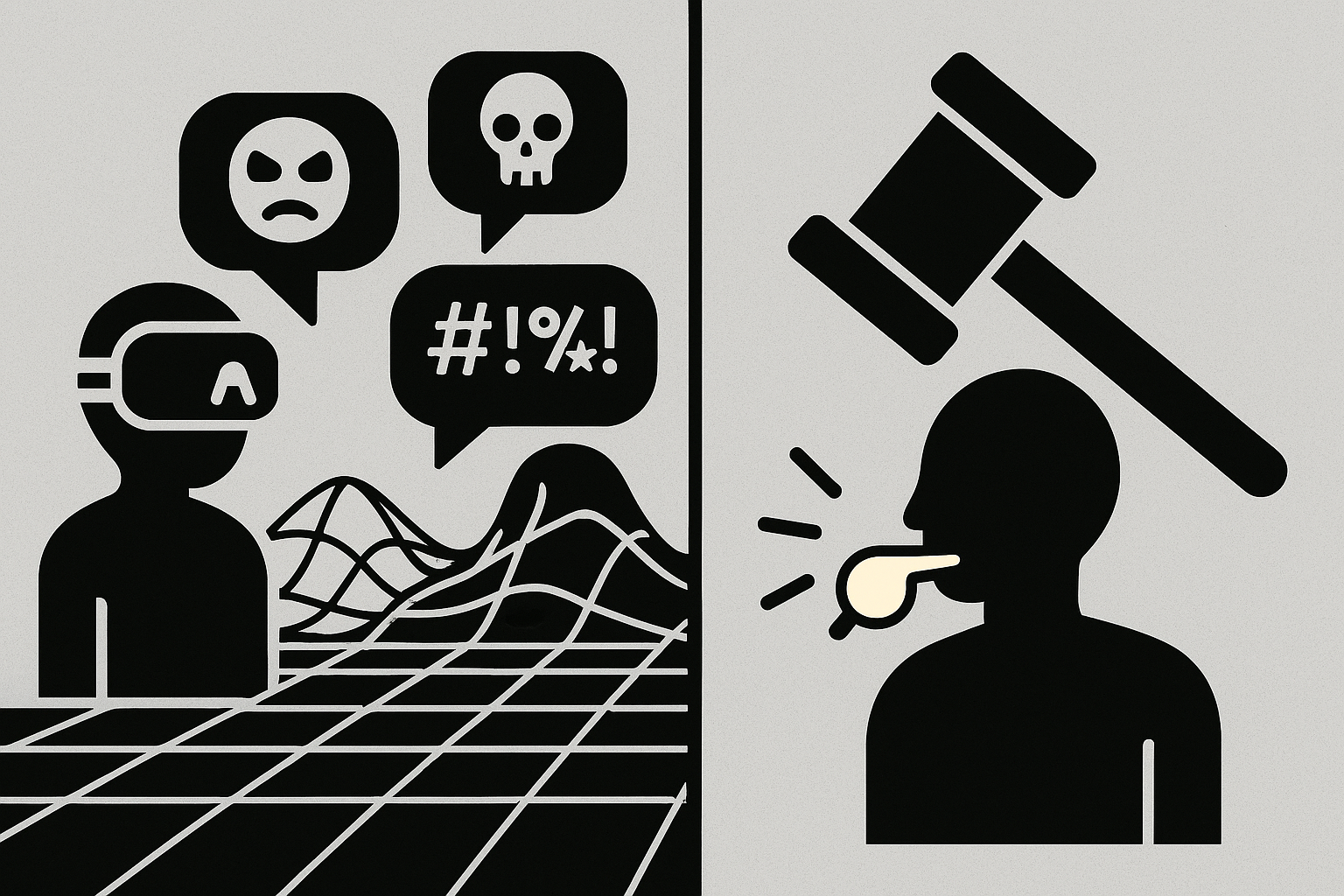
La falta de proximidad y el aumento del anonimato en los mundos virtuales parecen otorgar una especie de permiso a los usuarios de metaversos basados en Inteligencia Artificial (IA) para comportarse de forma inapropiada. El acoso, el abuso, la difusión del odio y la división, así como la manipulación de mentes en los metaversos, están creciendo exponencialmente debido a la velocidad y magnitud con la que los bots habilitados por IA pueden multiplicarse y reproducir contenido. La violencia en línea ha comenzado a trasladarse al mundo real, lo que está afectando negativamente la psique y el bienestar de niños, niñas y jóvenes en la sociedad. Personas éticas o empleados con buenas intenciones han alzado la voz contra estas violaciones en los metaversos. Sin embargo, muchos de estos grupos éticos han sido disueltos o silenciados, y quienes actúan como denunciantes suelen ser despedidos, desacreditados o ignorados. A los estudiantes de Ética Empresarial, Marketing, Gestión y Sostenibilidad a menudo se les pide simplemente que realicen un análisis ético de casos y proporcionen recomendaciones. Si bien estos procesos han contribuido a explorar diversas corrientes del pensamiento ético, la aplicación de estos conceptos a los metaversos basados en IA parece depender menos del marco teórico que se aplique y más de cómo diseñar un sistema a prueba de fallos que proteja la seguridad y el bienestar de todos. Este enfoque puede hacer que los estudiantes sean más conscientes de las consecuencias de sus decisiones y desarrollen un sentido de responsabilidad hacia el bienestar colectivo. Este artículo propone el uso de un estudio de caso de una empresa hipotética que posee una plataforma de metaverso y enfrenta diversos desafíos relacionados con el abuso y los escándalos en su entorno virtual. Además, se ofrece una revisión detallada con los pros y contras de varios marcos éticos y se plantean dos preguntas clave a los estudiantes, instándolos a diseñar una plataforma de metaverso que pueda: a) garantizar el bienestar, la seguridad y la protección de los usuarios que ni siquiera son conscientes de que sus mentes pueden estar siendo influidas y manipuladas; y b) encontrar una forma de convencer a las empresas creadoras de metaversos basados en IA de adoptar marcos éticos. Se proporcionan respuestas de ejemplo para ayudar al profesorado a trabajar con los estudiantes en la comprensión de la importancia de diseñar siempre productos y servicios pensando en el bienestar propio y ajeno, en lugar de centrarse únicamente en obtener beneficios a costa de la seguridad y la integridad de las personas.
Referencias
Anshari, M., Syafrudin, M., Fitriyani, N.L. & Razzaq, A. (2022) Ethical Responsibility and Sustainability (ERS) Development in a Metaverse Business Model, Sustainability,14, 15805. https://doi.org/10.3390/su142315805
Baloyan, S. (2022). What You Need to Know About Metaverses Now, Feb 1, 2022, https://hackernoon.com/what-you-need-to-know-about-Metaverses-now https://doi.org/10.4324/9781315744841-3
Behera, R.K., Janssen, M., Rana, N.P., Bala, P.K., & Chakraborty, D. (2024) Responsible metaverse: Ethical metaverse principles for guiding decision-making and maintaining complex relationships for businesses in 3D virtual spaces, Decision Support Systems, 187(3):114337 https://doi.org/10.1016/j.dss.2024.114337
Benjamins, R., Viñuela, Y.R. & Alonso, C (2023) Social and ethical challenges of the metaverse, AI and Ethics 3:689–697 https://doi.org/10.1007/s43681-023-00278-5
Brom, M. (2023) Legal Representation and the Metaverse: The Ethics of Practicing in Multiple Realities, Depaul Business & commercial Law Journal, 21: 125-143
Dayananda. (2011). Bhagavad Gita Home Study Course, 9 Volumes Arsha Vidya Research and Publication Trust, Chennai, ISBN: 978-93-80049-39-7
Diakopoulos, N., Trattner, C., Jannach, D., Costera, I. M. & Motta, E. (2024) Leveraging Professional
Ethics for Responsible AI , Communications of the ACM, 67 (2): 19-21
Giarmoleo, F. V., Ferrero, I., Rocchi, M., & Pellegrini, M.M. (2024) What ethics can say on artificial intelligence: Insights from a systematic literature review, Business Society Review, 129:258–292. https://doi.org/10.1111/basr.12336
Goyal, R. (2023). 14 Best Metaverse Platforms You Can Already Enter in 2024, https://geekflare.com/best-Metaverse-platforms/
Hartman, L.P., Desjardins, J. & MacDonald, C. (2014) Business Ethics: Decision-Making for Personal
Integrity and Social Responsibility, 3rd Edition McGraw-Hill. ISBN 978-0-07-802945-5.
Johnson, D.G. & Verdicchio, M. (2023) Computing Ethics: Ethical AI is not about AI, Communications of the ACM, 66 (2): 32-34 https://doi.org/10.1145/3576932
Knox, P. (2021). What is the Metaverse? Meaning explained, New York Post, Oct. 21, 2021. https://nypost.com/2021/10/21/what-is-the-Metaverse-meaning-explained/
Kupiers, B. (2023) AI and Society: Ethics, Trust, and Cooperation, Communications of the ACM, 66(8): 39-42 https://doi.org/10.1145/3583134
Lin, C-T (2023) All about the human: A Buddhist take on AI ethics, Business Ethics, eth Environment and Responsibility, 32:1113–1122. https://doi.org/10.1111/beer.12547
Macfarlane, B., Desjardins, J., & Lowry, D. (2004). “The Ethics of Teaching Business Ethics- A Reflective Dialogue,” Journal of Business Ethics Education, 1(1) pp: 43-54. https://doi.org/10.5840/jbee2004116
Nourbakhsh, I.R. (2021) AI Ethics: A Call to Faculty, Communications of the ACM, 64 (9): 44-45 https://doi.org/10.1145/3478516
Ohreen, D., Sundararajan, B., Trifts, V., & Comber, S. (2021) “Vygotskian Business Ethics: The Influence of Peers on Moral Reasoning in Business Ethics Education”., Journal of Management Education. Vol 46 (1), pp 1-36 - https://doi.org/10.1177/1052562921996019
Prasittichok P., & Klaykaew K.K. (2022). Meta-skills development needs assessment among undergraduate students. Heliyon, 8(1): e08787. https://doi.org/10.1016/j.heliyon.2022.e08787
Sætra, H.S., Coeckelbergh, M. & Danaher, J. (2023), The AI Ethicist’s Dirty Hands Problem, Communications of the ACM, 66(1): 39-41 https://doi.org/10.1145/3529751
Sales, N.J. (2024). A girl was allegedly raped in the Metaverse. Is this the beginning of a dark new future? The Guardian, Jan 5, 2024, https://www.theguardian.com/commentisfree/2024/jan/05/Metaverse-sexual-assault-vr-game-online-safety-Meta
Sinha, E (2023) ‘Co-creating’ experiential learning in the metaverse- extending the Kolb’s learning cycle and identifying potential challenges, The International Journal of Management Education 21(3):100875 https://doi.org/10.1016/j.ijme.2023.100875
Spence, E.H. (2008) Meta Ethics for the Metaverse: The Ethics of Virtual Worlds. In Proceedings of the 2008 conference on Current Issues in Computing and Philosophy. IOS Press, NLD, 3–12.
Stephen, K., Muir, L & Hall, H. (2020). Towards a definition of Metaskills, Information Research, 25(4), Proceedings of ISIC: the information behavior conference, Pretoria, South Africa, 28th September to 1st October 2020. https://doi.org/10.47989/irisic2010
Torsten, F. (2022) Meta Learning in Metaverse, IM + io, 2022, Issue 2, p82-85. 4p
Wines, W.A. (2008) Seven Pillars of Business Ethics: Toward a Comprehensive Framework, Journal of Business Ethics, 79:483–499 https://doi.org/10.1007/s10551-007-9411-7
Yadollahi A, and Yazdani S. (2020). Defining Cognitive, Higher Order Thinking, and Psychomotor Meta-Skills: Three-Curricular Content Concept Analysis. Journal of Medical Education. 2020;19(3): e110334. https://doi.org/10.5812/jme.110334.
Yasuda, A (2024) Metaverse ethics: exploring the social implications of the metaverse, AI and Ethics, https://doi.org/10.1007/s43681-024-00507-5
Zheng, D. and Daugherty, P (2023) Building a Responsible Metaverse, Accenture Report
Zhuk, A. (2024) Ethical implications of AI in the Metaverse, AI and Ethics, https://doi.org/10.1007/s43681-024-00450-5
Descargas
Publicado
Número
Sección
Licencia
Derechos de autor 2025 Journal of Management and Business Education

Esta obra está bajo una licencia internacional Creative Commons Atribución-NoComercial-CompartirIgual 4.0.
License terms at: https://creativecommons.org/licenses/by-nc/4.0/legalcode